

Fire alarm upgrade, retrofit and migration
Fire Alarm System Upgrade, Retrofit & Migration with Siemens
An obsolete fire alarm system becomes progressively more expensive, less reliable, and harder to keep functional — and when spare parts run out, a single panel failure can mean weeks of fire watch, failed annual inspections, and rising insurance exposure. A planned, phased Siemens migration avoids all of it.
Upgrading or migrating a third-party or older Siemens system
The money spent keeping an obsolete and ageing system operational over three to five years — emergency callouts, scavenged parts, fire watch — often approaches or exceeds the cost of a planned, phased migration, and at the end of it, the owner of the facility still has an obsolete system. Upgrading at your own schedule with a phased approach that suits your budget and the urgency of the system is almost always cheaper than upgrading after a failure forces your hand.
Migrating from an older Siemens system
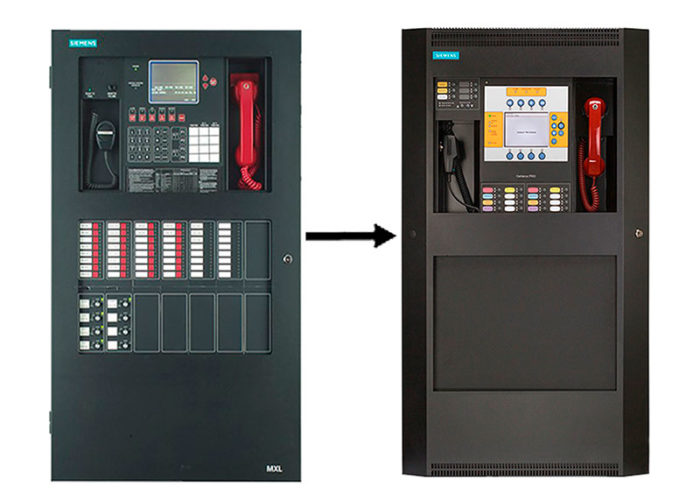
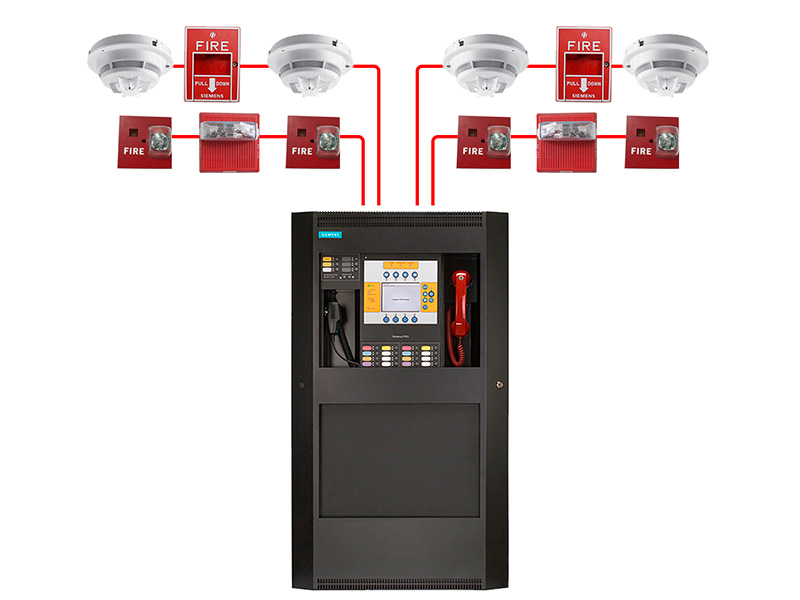
- Siemens designs its current platforms (Cerberus PRO) with defined migration paths from earlier generations. Depending on the specific legacy system and region, some existing wiring — and in certain cases compatible field devices — can be retained, reducing cost and disruption.
- Existing loop wiring can frequently be reused after testing, meaning the migration may be primarily a panel and head-end replacement with progressive device swaps.
- Programming data and address schemes from the legacy system can often inform the new configuration, speeding up commissioning.
Migrating from a third-party system
- Most fire alarm protocols are proprietary. Third-party addressable detectors and modules generally cannot communicate with a Siemens panel and will need replacement.
- The existing field wiring is usually the biggest reusable asset. If cabling meets code and passes testing (insulation resistance, continuity, capacitance/loop limits), device-for-device replacement over existing wiring is often possible.
- Conventional (non-addressable) zones are simpler to migrate than addressable loops — conventional wiring can typically be connected to new addressable input modules or reused with new conventional-compatible circuits.
Phased migration to maintain protection
A building can never be left unprotected during the works. Common strategies we deploy include:
- Parallel operation: install the new panel alongside the old one and migrate loops/zones one at a time, keeping both systems live until cutover is complete.
- Loop-by-loop or floor-by-floor migration: minimizes the area affected at any one time; well suited to occupied buildings such as hospitals, hotels, and high-rises.
- Temporary interfaces: in some projects, monitor the old system’s common alarm/trouble outputs through the new panel (or vice versa) during the transition so the monitoring station always receives signals from a single point.
- Fire watch: where portions of the system must be taken offline, coordinate fire watch requirements with the owner, insurer, and the authority having jurisdiction (AHJ) in advance.
- After-hours work: schedule cutovers, loop transfers, and audible testing outside occupied hours where possible.
Codes, standards & sign-off
Compliance and approvals
- Any replacement or substantial modification generally triggers compliance with current codes and standards — not the codes in force when the original system was installed. This means the applicable building/fire codes plus ULC standards (e.g., CAN/ULC-S524 for installation and CAN/ULC-S537 for verification).
- Engage a qualified engineer/designer for stamped design drawings where required, including riser diagrams, battery calculations, voltage-drop calculations, and updated sequence-of-operations matrices.
- Verify audibility and visibility coverage against current requirements — older systems frequently fall short of today’s sound-level and strobe-coverage rules, so expect to add notification appliances.
- Confirm the new panel’s connection to a listed monitoring station and update the account/signal information before and after cutover.
- Elevator recall, suppression releasing, and voice evacuation each carry their own specific code requirements and interface details — treat them as distinct sub-scopes.
Take advantage of the upgrade
A migration is the right moment to add capabilities the old system lacked:
- Multi-criteria/intelligent detectors to reduce nuisance alarms (a major benefit over legacy ionization or basic photoelectric heads).
- Networked panels and graphical head-end/workstation for multi-building or campus sites.
- Remote diagnostics and cloud-connected service tools for faster fault response.
- Integration with building management, access control, and mass notification/voice evacuation systems.
- Degrade-gracefully architecture: loop isolators, redundant network paths, and distributed intelligence so a single fault doesn’t disable large areas.
Frequently asked questions
My old system still works. Why should I upgrade now instead of waiting for it to fail?+
Can you migrate a non-Siemens (third-party) system to Siemens?+
I have an older Siemens system. Can any of it be kept?+
Can my existing wiring really be reused?+
Will my building be unprotected during the migration?+
Can the migration be spread across multiple budget years?+

Ready to retire your obsolete system?
Contact us for a free assessment of your existing fire alarm system. We will show you exactly what can be reused, what needs to be replaced, and how a phased Siemens migration can be delivered on your timeline and budget — without ever compromising the safety of your building and its occupants.